-
Courses

Courses
Choosing a course is one of the most important decisions you'll ever make! View our courses and see what our students and lecturers have to say about the courses you are interested in at the links below.
-
University Life
University Life
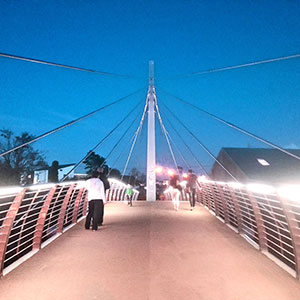
Each year more than 4,000 choose University of Galway as their University of choice. Find out what life at University of Galway is all about here.
-
About University of Galway
About University of Galway
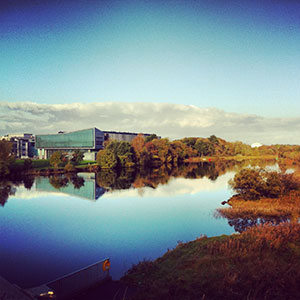
Since 1845, University of Galway has been sharing the highest quality teaching and research with Ireland and the world. Find out what makes our University so special – from our distinguished history to the latest news and campus developments.
-
Colleges & Schools
Colleges & Schools
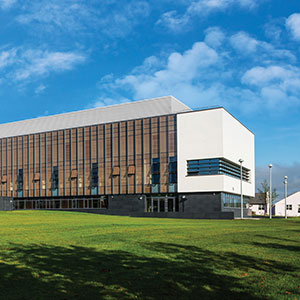
University of Galway has earned international recognition as a research-led university with a commitment to top quality teaching across a range of key areas of expertise.
-
Research & Innovation

Research & Innovation
University of Galway’s vibrant research community take on some of the most pressing challenges of our times.
-
Business & Industry
Guiding Breakthrough Research at University of Galway
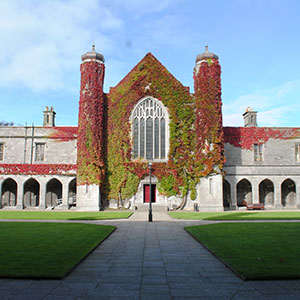
We explore and facilitate commercial opportunities for the research community at University of Galway, as well as facilitating industry partnership.
-
Alumni & Friends

Alumni & Friends
There are 128,000 University of Galway alumni worldwide. Stay connected to your alumni community! Join our social networks and update your details online.
-
Community Engagement
Community Engagement
At University of Galway, we believe that the best learning takes place when you apply what you learn in a real world context. That's why many of our courses include work placements or community projects.








Bachelor of Engineering (Civil)
Bachelor and Master of Engineering (Civil)
.jpg)
.jpg)
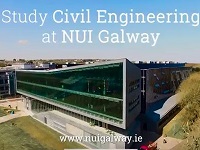

Entry Points (2023)
512
Course Overview
Civil Engineering is concerned with the planning, design, construction and maintenance of the built environment. It encompasses minor and major structures, ranging from drainage systems, houses, commercial buildings, roads and bridges to multi-story buildings and water and wastewater treatment facilities. The work of civil engineers is most visible in the structures in which we live and work. Their contribution is also seen in transportation systems that we use on a daily basis such as subways, motorways, railways, airports and harbours. They are also involved in the design, construction and operation of complex water supply and sanitation systems for our ever-growing cities. In such projects and more generally, they perform a critical public and environmental health function as well.
The Civil Engineering degree programme sets out to develop the scientific, technical, organisational, IT and communication skills needed for a satisfying and rewarding career as a Civil Engineer.
Civil Engineers work in rapidly changing and challenging areas using traditional and new materials and techniques, and increasingly incorporating IT solutions at design and construction stage. You could be involved in schemes from design to management stage through to completion in what are often highly complex projects. Therefore, the profession combines creative skills with an aptitude for mathematics and technical subjects. At the most challenging end of the profession, where the management of large projects is involved, a high degree of administration skills are also required.
If you think you might enjoy developing and constructing bridges, tunnels, roads, railways, major building or other infrastructural projects, you should consider Civil Engineering. The skills you will learn will give you opportunities for work worldwide wherever development is taking place; not least in the fast-growing economies of the BRIC countries (Brazil, Russia, India and China).
Integrated Masters (ME) and Work placement
All students registering for an engineering degree at NUI Galway will be enrolled on an integrated five year programme; a Bachelor of Engineering (BE) (four years, Level 8) + a Master of Engineering (ME) (one year, Level 9). Upon successful completion of the five years of study, graduates will have the educational qualifications required for progression to Chartered Engineer. Students registering for an engineering degree at NUI Galway in 2019 will make a decision at the beginning of 3rd Year to either remain on the BE+ME pathway (five years) or exit with a BE (four years). Students on the BE+ME pathway will avail of advanced engineering modules, a substantial research and development project, and a work placement of eight months duration during the 4th Year. For students exiting with a BE, the work placement will be of four months duration after 3rd Year.
Read more about Engineering work placements.
Accreditation
All Engineering Degrees at NUI Galway are professionally accredited by the statutory professional body, Engineers Ireland. This “Accreditation” means that the degree has been assessed and approved to meet the educational requirements for professional Engineers.
- Under an international agreement (Washingon Accord), any Degree accredited by the National professional body (Engineers Ireland) is recognized internationally. So having an “Accredited” degree means that employers outside of Ireland can (1) understand the quality/education achieved by a graduate and (2) know that it is equivalent to their own Education system/standards, and (3) can offer appropriate employment on this basis. For example, certain functions (sign off on large civil engineering construction projects) can only be carried out by a chartered engineer.
- Engineers Ireland changed the criteria for Accreditation in 2012, and now require a Masters (Level 9) qualification as the education standard required for Registered Professional Titles of Chartered Engineer* (prior to this, a Level 8 degree was required). The changes were implemented because the standard European engineering qualification (degree or diplome) is at level 9, and European industry maintains a strict differentiation between those engineers qualified at level 9 and those qualified at level 8. Any graduate interested in working in Europe/Worldwide is now strongly advised to get an accredited level 9 award.
- Engineers Ireland accreditation can be obtained at the following levels:
- Level 8: 4-year honours degree – associate engineer
- Level 9: 5-year masters degree – chartered engineer
*A Chartered Engineer is the highest professional education standard in Engineering. A chartered Engineer is competent (because of their education and training) to assume personal responsibility for the development and application ofengineering in research, design, construction, manufacturing, superintending, managing and in the education of the engineer. His/her work is predominantly intellectual and varied and not of a routine mental or physical character. It requires the exercise of original thought and judgement and the ability to supervise the technical and administrative work of others.
Applications and Selections
Who Teaches this Course
Requirements and Assessment
Key Facts
Entry Requirements
Minimum Grade H5 in two subjects and passes in four other subjects at O6/H7 Level in the Leaving Certificate, including Irish, English, Mathematics, a aboratory science subject (i.e., Chemistry, Physics, Biology, Physics with Chemistry (joint), Agricultural Science or Computer Science) or Technology, and any two other subjects recognised for entry purposes. Additional requirements: Minimum H4 in Mathematics or, alternatively, obtain a pass in the Engineering Maths Qualifying Exam (held in the University).
Additional Requirements
Students must obtain a minimum of Grade H4 in the Higher Level Leaving Certificate paper in Mathematics or, alternatively places available (which may vary in number year to year) may be allocated to those candidates who have achieved the points requirement for the programme that year, who satisfy the general requirements for Matriculation in the College of Engineering and Informatics and who attain a Pass in the Engineering Maths Qualifying Examination. The places available will be allocated in strict order of merit based points attained in the Leaving Certificate. Due to capacity constraints, not all candidates who achieve a pass in the examination may receive an offer.
For A-levels: A minimum of Grade C in Mathematics is required
For A-levels: A minimum of Grade C in Mathematics is required
Recognition of Prior Learning (RPL)
Duration
4 years
Next start date
September 2024
A Level Grades (2023)
universityofgalway.ie/alevels
Average intake
50
QQI/FET FETAC Entry Routes
Closing Date
NFQ level
Mode of study
ECTS weighting
Award
CAO
GY402
Course code
Course Outline
Year 5 optional
At the School of Engineering we are focused on ensuring that you will be educated to the highest standards, and will have the necessary qualifications to avail of all of the professional opportunities presented to you, both in Ireland and across the world. You will be enrolled on an integrated five year programme; a Bachelor of Engineering (BE) (four years, Level 8) + a Master of Engineering (ME) (one year, Level 9). Students on the BE+ME pathway will avail of advanced engineering modules, a substantial research and development project, and a work placement. Upon successful completion of the five years of study, graduates will have the educational qualifications required for progression to Chartered Engineer. Full information on the optional 5th Year is provided here.
Curriculum Information
Curriculum information relates to the current academic year (in most cases).Course and module offerings and details may be subject to change.
Glossary of Terms
- Credits
- You must earn a defined number of credits (aka ECTS) to complete each year of your course. You do this by taking all of its required modules as well as the correct number of optional modules to obtain that year's total number of credits.
- Module
- An examinable portion of a subject or course, for which you attend lectures and/or tutorials and carry out assignments. E.g. Algebra and Calculus could be modules within the subject Mathematics. Each module has a unique module code eg. MA140.
- Subject
- Some courses allow you to choose subjects, where related modules are grouped together. Subjects have their own required number of credits, so you must take all that subject's required modules and may also need to obtain the remainder of the subject's total credits by choosing from its available optional modules.
- Optional
- A module you may choose to study.
- Required
- A module that you must study if you choose this course (or subject).
- Required Core Subject
- A subject you must study because it's integral to that course.
- Semester
- Most courses have 2 semesters (aka terms) per year, so a three-year course will have six semesters in total. For clarity, this page will refer to the first semester of year 2 as 'Semester 3'.
Year 1 (60 Credits)
Required EI140: Fundamentals of Engineering - 10 Credits - Semester 1Required CT1110: Engineering Computing I - 5 Credits - Semester 1
Required EI160: Engineering Graphics - 5 Credits - Semester 1
Required CH140: Engineering Chemistry - 5 Credits - Semester 1
Required MP120: Engineering Mechanics - 5 Credits - Semester 1
Required MA140: Engineering Calculus - 5 Credits - Semester 1
Required PH140: Engineering Physics - 5 Credits - Semester 2
Required CT1111: Engineering Computing II - 5 Credits - Semester 2
Required EI150: Engineering Design - 10 Credits - Semester 2
Required MM140: Engineering Mathematical Methods - 5 Credits - Semester 2
Year 2 (60 Credits)
Required CE227: Strength of Materials - 10 Credits - Semester 3Required CE2100: Building Information Modelling - 5 Credits - Semester 3
Required CE2101: Principles of Building - 5 Credits - Semester 3
Required ME223: Thermodynamics and Fluid Mechanics - 5 Credits - Semester 3
Required ST1100: Engineering Statistics - 5 Credits - Semester 3
Required MA2101: Mathematics and Applied Mathematics I - 5 Credits - Semester 3
Required CE2103: Construction Practice - 5 Credits - Semester 4
Required CE222: Civil Engineering Materials and Design - 5 Credits - Semester 4
Required CE224: Engineering Hydraulics I - 5 Credits - Semester 4
Required CE2102: Community Engaged Building Project - 5 Credits - Semester 4
Required MA2102: Mathematics and Applied Mathematics II - 5 Credits - Semester 4
Year 3 (60 Credits)
Required CE3112: Water Engineering Design and Practice - 5 Credits - Semester 5Required CE3103: Design of Structures I - 5 Credits - Semester 5
Required CE343: Sustainable Energy - 5 Credits - Semester 5
Required CE344: Transportation Systems and Infrastructue I - 5 Credits - Semester 5
Required CE3119: Theory of Structures - 5 Credits - Semester 5
Required CE3105: Environmental Engineering - 5 Credits - Semester 5
Required CE3113: Engineering Hydraulics II - 5 Credits - Semester 5
Required CE3104: Design of Structures II - 5 Credits - Semester 6
Required CE3107: Geomechanics I - 5 Credits - Semester 6
Required CE3120: Mechanics of Solids - 5 Credits - Semester 6
Required CE466: Energy in Buildings - 5 Credits - Semester 6
Required CE471: Project Management - 5 Credits - Semester 6
Year 4 (60 Credits)
Required CE4104: Professional Experience Programme in Civil Engineering - 20 Credits - Semester 7Required CE4101: Design of Structures III - 10 Credits - Semester 7
Required CE4102: Geomechanics II - 5 Credits - Semester 7
Required CE472: Structural Analysis - 5 Credits - Semester 7
Required CE469: Hydrology and Water Resource Engineering - 5 Credits - Semester 7
Required CE464: Design of Sustainable Environmental Systems I - 5 Credits - Semester 7
Required CE338: Project Planning & Organisation II - 5 Credits - Semester 8
Required BSS2104: Introduction to Sustainability 2 - 5 Credits - Semester 8
Further Education
Upon completion of the undergraduate degree, suitably qualified students have the option to enrol and continue their studies to Master’s or PhD level.
Students can advance to Master’s level (ME) through our one year taught Master’s programme (September-June) that builds on the successful completion of their undergraduate programme, subject to a sufficient standard (2nd Class Honours minimum). This programme is an integrated follow-on to the BE programme and is designed to meet Engineers Ireland’s criterion for Level 9 degrees, providing graduates with a route to Chartered Engineer status that will be recognised worldwide.
Master’s degree education is becoming increasingly the norm internationally in Engineering, and this programme strengthens the ability of our graduates to compete nationally and internationally at the highest level for employment in industry and other sectors of the economy.
In our PhD programme, students develop innovative state-of the-art solutions to current problems in civil engineering. Students will specialise in one of the discipline’s areas of research, working with a high degree of independence and becoming experts on their chosen topic. This work is usually presented at international conferences and published in journals.
Why Choose This Course?
Career Opportunities
Graduates from this programme will find employment in:
- Consulting/Contracting (dealing e.g. with Structures, Transportation, Public Health, Offshore and Coastal Engineering)
- Government Departments
- Semi-State Organisations
- Local Authorities
Who’s Suited to This Course
Learning Outcomes
Transferable Skills Employers Value
Work Placement
Study Abroad
Related Student Organisations
Course Fees
Fees: EU
€7,268 p.a. (€7,408 p.a. including levy) 2024/25
Fees: Tuition
€4,268 p.a. 2024/25
Fees: Student Contribution
€3,000 p.a. 2024/25
Fees: Student levy
€140 p.a. 2024/25
Fees: Non EU
€26,000 p.a. (€26,140 p.a. including levy) 2024/25
EU Fees are comprised of Tuition + Student Contribution Charge + Student Levy** €140. **Payable by all students and is not covered by SUSI. Further detail here.
Please note that the fee structure in the fifth year differs and is considered a Postgraduate course for funding purposes. Please see here for rates charged in 2023/24.
Find out More
Deirdre DuaneCivil EngineeringEmail: civilengineering@universityofgalway.ie
What Our Students Say

James Boyce | BA (Civil Engineering)
As a very mature student (with over 25 years in a previous career) I am now in my final year in Civil Engineering. My experience of the course has been both challenging and rewarding. I have built up a strong wide-ranging knowledge base. This has been achieved through a well designed and structured course presented by helpful and supportive lecturers. I have thoroughly enjoyed the course (even though studying has been hard at times) and this is due in no small way to the friendliness of my fellow students and the open and easy atmosphere of the University itself.
What Employers Say

Majella Henchion, BE MSc | Networks Programme Owner, ESB
As a major employer of graduates from University of Galway’s Energy Systems, Mechanical, Civil and Electrical/Electronic Engineering programmes, ESB welcomes the establishment of University of Galway’s integrated five-year Accredited Master of Engineering degrees. We see great value in the additional educational attainment in and of itself but also as a key step in progression towards Chartership which is important for our Engineers because of the critical infrastructural nature of our work and the general management capability Chartership represents. ESB also welcomes the positioning of the work placement programme between the fourth and fifth years of study as it will enable the students to be given greater responsibility and experience a greater range of ESB’s work in the energy sector. We believe the movement of the industry placement makes it of greater value to the student, the undergraduate employer and to any post-graduate employer of that engineer.

Declan Costello | Senior R&D Manager, Medtronic
Medtronic welcomes the expansion of the University of Galway Engineering programs to an integrated five-year Accredited Master of Engineering degree. Medtronic already employs a large number of University of Galway Engineering graduates and the move to a five-year program aligns with international best practice, provides a more highly educated talent pool and facilitates an extended work placement which is hugely beneficial to both the company and the student.